01
The provider's own API
priced- OpenAI
- Anthropic
They speak their own endpoints.
Backstop addsBudgets, breaker, concurrency — and a price, read from the catalogue that ships inside Backstop.
00 — Up and running
Install the package, run the keyless proof, and watch a runaway loop get stopped before a single request leaves your machine.
Step 01
One package, standard library plus httpx. Python 3.10 or newer.
Step 02
backstop verify wraps a real client against a local mock transport and blocks a runaway loop. No API key needed.
Allowed calls     2
Blocked calls     8
Tokens saved      2,000
Wall-clock overhead 0.08 ms

Status: VERIFIED (real wrap enforcement active)
Step 03
Eight of ten runaway calls blocked before dispatch, against a 500-token budget. The two that were allowed completed inside it. Nothing was billed, because nothing was sent.
01 — What actually goes wrong
They fail on ten thousand good ones in a row. Three shapes, and all three have the same cause.
01
The tool errors, the agent retries, the retry errors too. The loop is not a bug in the model — it is a missing stopping condition, and it bills you every turn.
02
Ten agents share a process. One of them wants the whole window, and the other nine are fine right up until they are not.
03
Every attempt is a billed attempt. A breaker that never opens turns a provider outage into your invoice.
None of these is a model problem. All of them are a missing limit.
02 — How it works
No proxy, no sidecar, no changes to the code that calls the model. The transport is injected in-process, so requests still go straight to the provider.
Step 01
The wrapped client behaves like the one you had. Same methods, same arguments, same return value.
from openai import OpenAI
from backstop import Backstop, BackstopConfig

client = Backstop.wrap(
    OpenAI(),
    budget=50_000,     # token ceiling
    config=BackstopConfig(
        initial_concurrency=4,
    ),
)
Step 02
A ceiling in tokens, a ceiling in money, a cap on requests in flight, and when to open the breaker.
client = Backstop.wrap(
    OpenAI(),
    # tokens, and dollars on top
    budget=50_000,
    budget_usd=Decimal("5.00"),
    config=BackstopConfig(
        initial_concurrency=4,  # in flight
    ),
)
Step 03
When the budget is reached the request never leaves your machine, and one exception is raised. It is a subclass of the provider's own error, so the handlers you already wrote still catch it.
from backstop.exceptions import BudgetExceededError

try:
    response = client.chat.completions.create(...)
except BudgetExceededError as exc:
    # A subclass of openai.OpenAIError, so the
    # handlers you already have still catch it.
    log.warning("Budget reached", extra={"used": exc.tokens_used})
Step 04
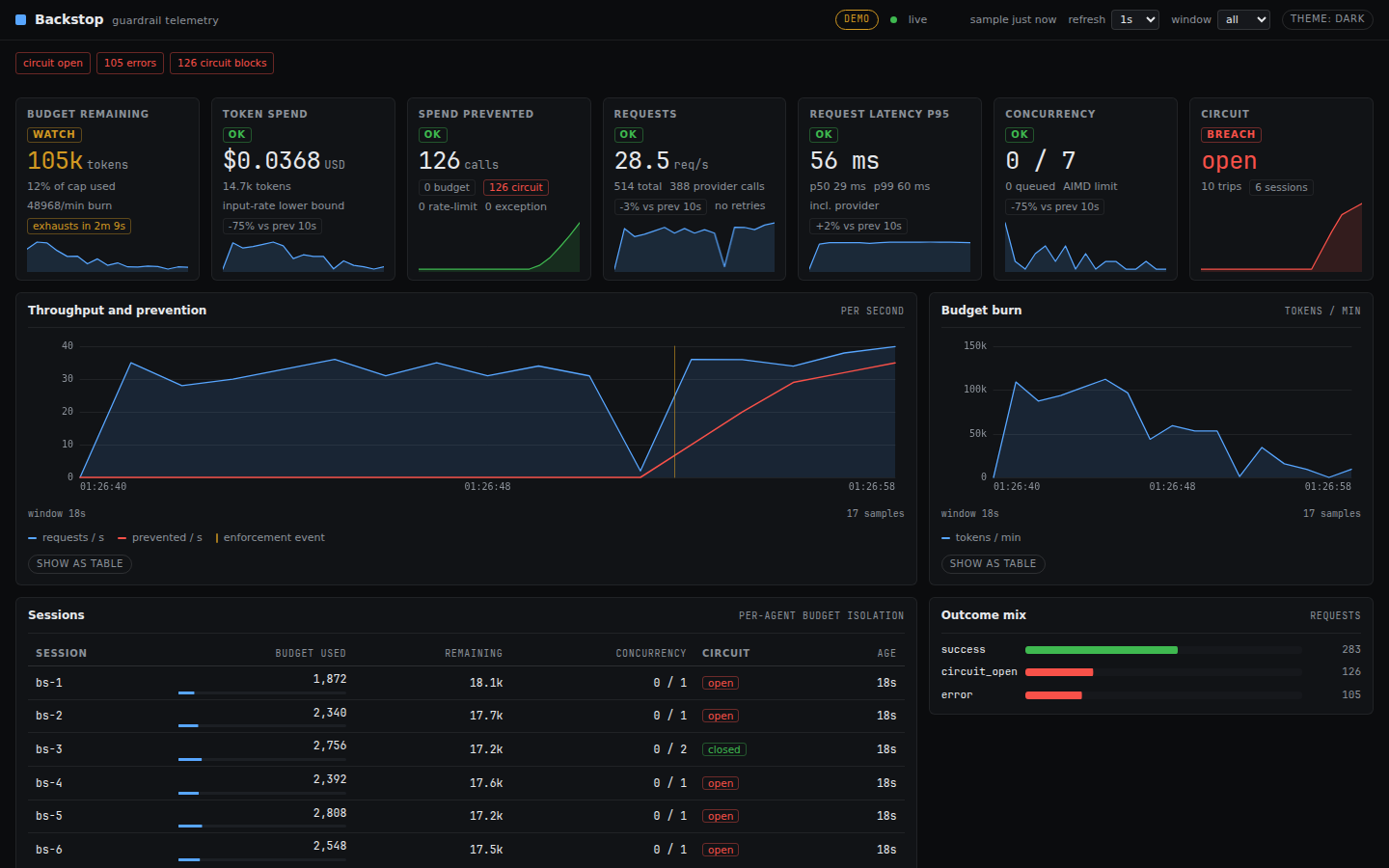
backstop dashboard opens a live view of budgets, burn rate, breaker state and every enforcement decision — with no Prometheus and no exporter. And every decision is written to a hash-chained audit log you can replay afterwards.
03 — Where it can point
Backstop does not know what a provider is. It counts requests, dollars and concurrency — so it works with anything that speaks the OpenAI-compatible protocol, and with the two that do not.
01
They speak their own endpoints.
Backstop addsBudgets, breaker, concurrency — and a price, read from the catalogue that ships inside Backstop.
02
They speak an OpenAI-compatible endpoint.
Backstop addsThe same budgets, the same breaker, the same concurrency limit. No price until you file one.
03
They speak an OpenAI-compatible endpoint.
Backstop addsThe same budgets, the same breaker, the same concurrency limit. No price until you file one.
04
They speak an OpenAI-compatible gateway.
Backstop addsThe same budgets, the same breaker, the same concurrency limit. No price until you file one.
22 servers. One wire protocol, one enforcement engine, no per-provider plugin. The only thing that changes between them is the price list: OpenAI and Anthropic models are priced from the catalogue that ships inside Backstop, and everything else is unpriced until you file a price for it — because a dollar ceiling with no price is a guess, and a guess is not a limit.
How to point it at one·The compatibility matrix·How the dollar budget works
04 — What you get
Every one of them is a limit you can turn on, or leave off. The defaults are the boring ones.
01
A hard ceiling per session, per agent, or per a hierarchy of them. When it is reached, the next request never leaves your machine.
02
The same ceiling in money, priced from the model you actually call, with the arithmetic done in decimals so a cent out is a cent out.
03
When the provider starts failing, stop sending it requests. It half-opens, tries one, and closes again if the provider recovered.
04
A limit on requests in flight, with a queue that prioritises instead of dropping. Critical work goes first; nothing is discarded.
05
Each wrapped client carries its own budget. One agent cannot spend another's, and a parent can cap a whole tree of children.
06
Four detectors that notice a spend pattern — velocity, drift, retry amplification, context growth — before it becomes an invoice.
07
Budgets, burn rate, breaker state and enforcement events, in a browser, with no Prometheus and no exporter to install.
08
Every enforcement decision, hash-chained, so you can prove afterwards what was allowed and what was stopped.
05 — In plain words
06 — See it
Not a screenshot of a product that needs a server to go with it. A dependency-free view of the process you are already running, bound to loopback, making no outbound requests.
07 — Proof
backstop verify runs a real wrap against a local mock transport, blocks a runaway, and prints what it measured. If it cannot prove the limits work, it says so and exits non-zero.
# Backstop Verify — 30-Second Keyless Proof

Mode: offline (local mock transport, zero network, zero keys)
Provider: openai (gpt-4o-mini simulation)

| Metric             | Result              |
|--------------------|---------------------|
| Allowed calls      | 2                   |
| Blocked calls      | 8                   |
| Tokens reserved    | 500                 |
| Tokens saved       | 2,000               |
| Exception surfaced | BudgetExceededError |
| Wall-clock overhead| 0.08 ms             |

## Mechanism Checks
- [PASS] config valid: BackstopConfig() built with sane bounds.
- [PASS] wrap pipeline: served a mock request end-to-end.
- [PASS] budget block: 8/10 runaway calls blocked at 500 tokens.
- [PASS] overhead: control-path p99 = 0.080 ms (direct 0.261 ms).
- [PASS] cache hit: the second identical request came from cache.
- [PASS] per-agent isolation: agent A blocked 5/5 at its own cap
        while agent B kept serving.

Summary: 8 passed, 0 warn, 0 failed, 0 skipped
Status: VERIFIED (real wrap enforcement active)08 — What it does not do
Every product has a boundary. This one draws it in public, because a guardrail you misunderstand is worse than no guardrail.
Nothing routes through Backstop. The transport is injected in-process and requests go to the provider directly, so there is no network hop to pay for and no second place to operate.
There is no Backstop server, no shared policy service, and nothing to sign up for. The limits live in the process that owns the traffic.
If you need to fail over between providers, use a gateway. Backstop's fallback chain stays inside one provider, on purpose.
Metrics are yours to ship. Backstop emits them and you send them where you like — there is no collector, no retention, and no query language here.
The runaway detectors report; they never block, cancel or kill. Enforcement is the budget's job, and the budget is explicit.
The long version, with the reasoning and the trade-offs, is inthe threat model.
09 — Questions
By about a tenth of a millisecond at the median, measured on two payload sizes and published with the conditions it was measured under. The guardrail has to read and price every request, so the cost is proportional to the body.
No. You wrap the SDK client once and keep calling it the way you already do. The only other change is catching one exception type when a budget is reached — and it subclasses the provider's own error, so handlers you already have keep working.
The request is refused before it is dispatched, and a BudgetExceededError is raised. Nothing is billed, because nothing was sent. The decision is written to the audit log.
The Python package is the complete implementation. A TypeScript port of the core is in progress and is not yet a drop-in replacement — the repository says so rather than the marketing page.
No. The built-in dashboard reads the process's own state and needs nothing installed beyond the standard library. Prometheus and OpenTelemetry are there if you want them, and the dashboard tells you whether they are live.
Nowhere, unless you ask. Backstop runs in your process: no hosted control plane, no collector, no upload. The optional spend ledger writes a local NDJSON file on the machine that made the requests, and you choose the path.
It is already self-hosted — it is part of the package and binds to loopback. Expose it further with a bearer token (--host 0.0.0.0 --token …). There is nothing to deploy.
Because nothing leaves your process, residency is whatever your own deployment already is. Backstop ships no SaaS and stores no telemetry; audits are hash-chained locally.
Those are gateways: your traffic goes through their server, and the guardrail lives on the network path. Backstop is in-process — the limits run inside the process that calls the model, so there is no network hop, no second place to operate, and no signup. Use a gateway if you need to route between providers; use Backstop if you want a hard ceiling on a specific agent.
10 — Proof you can check
Backstop ships no customer logos yet. It ships things you can verify yourself in thirty seconds.
Thirty seconds, no key, no account, no network.